


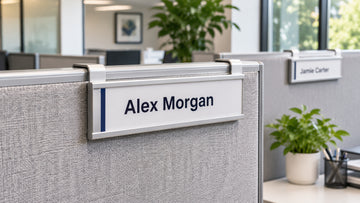
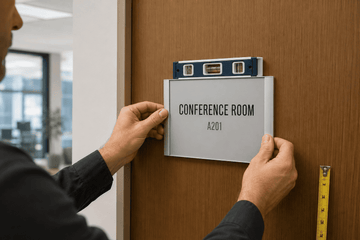
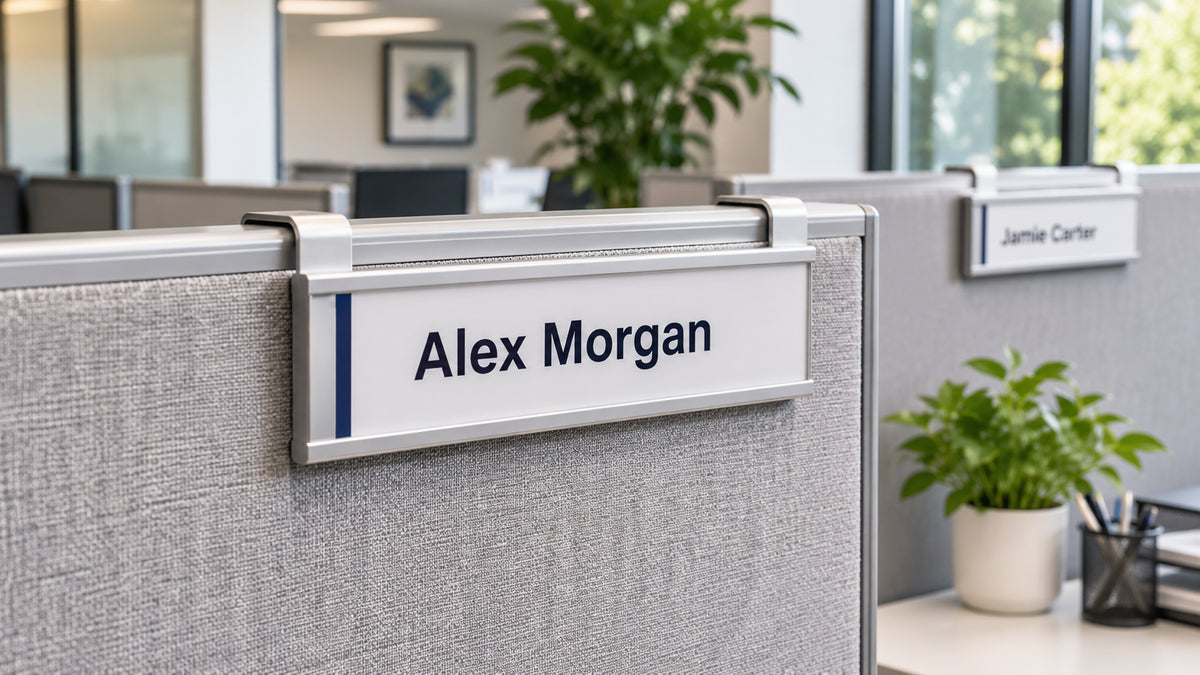
To hang a nameplate on a cubicle wall without puncturing the fabric, start with a properly fitted over-the-top partition bracket. If the panel has a compatible fabric surface, hook-fastening tape may also work without pins. Neither option is automatically damage-free: the right choice depends on the panel covering, top-rail shape, sign weight, and hardware fit. Cubicle pins are another option for suitable fabric panels, but they penetrate the surface and should not be described as a no-hole solution.
Before ordering hardware for a whole office, test one complete sign on one representative workstation. That small check can prevent a much larger problem when you discover that similar-looking cubicles have different fabrics or rail widths.
Check the cubicle before choosing a mounting method
A cubicle wall is not the same thing as a drywall wall. The visible surface may be woven fabric, a smooth laminate, glass, or a combination of materials. Under fabric, the panel construction can vary. Do not assume a fastener is appropriate just because the outside feels soft.
Record the surface material, the thickness across the top edge, and any raised or curved trim. Measure where the bracket will actually sit, rather than measuring a thinner section lower on the panel. Check whether shelves, overhead storage, or cables obstruct that location.
Next, consider the finished sign, not just its insert. A holder, printed insert, and accessories all add to the load. If the hardware instructions do not establish compatibility with your sign and panel, ask before installing it. For leased workstations, check the furniture provider's restrictions as well.
Cubicle nameplate mounting options compared
| Method | Suitable starting point | Practical advantage | Limitation or surface risk |
|---|---|---|---|
| Cubicle pins | Fabric-faced panels approved for pins | An alternative when hook tape will not hold | Punctures the fabric; unsuitable for a strict no-hole requirement |
| Hook-fastening tape | Fabric that securely engages the hooks | No pins through the panel when hooks grip the fabric directly | May not grip tight weaves; removal can disturb fibers |
| Partition clips or brackets | A compatible exposed rail or panel edge | Can avoid adhesive on the panel face | Incorrect fit or overtightening can mark trim; designs vary |
| Over-the-top sign holder | An accessible top edge with matching dimensions | Supports a sign without piercing the fabric face | Needs clearance and correct fit; rubbing or pressure can still leave marks |
These categories can overlap. An over-the-top bracket is one type of partition mounting hardware, while a double-sided holder describes how the sign displays information. A double-sided sign still needs a compatible mounting method.
Cubicle pins: useful when small holes are acceptable
Purpose-made cubicle pins attach small signs to suitable fabric-faced partitions. Office Nameplates' standard cubicle pins, sold as a set of two, are described for this use and as an alternative when hook-and-loop mounting is not holding.
Choose pins only when the panel manufacturer permits them and facilities staff accept the possibility of puncture marks. Do not force pins into hard trim or an unknown panel core. Follow the fastener instructions for attaching the pin hardware to the sign and inserting it into the panel.
Hook-and-loop fasteners: check the fabric first
Hook-and-loop mounting is not one universal installation method. Some systems use two mating strips, while hook-only tape may engage compatible cubicle fabric directly. These are different applications with different surface risks.
The Hook Only Velcro Mounting Tape for Office Signs has an adhesive backing and a hook fastening face. For a compatible fabric application, the adhesive side attaches to the sign and the hooks engage the panel fabric. Do not assume ordinary cubicle upholstery will hold the hooks securely.
Test an inconspicuous area with permission. Check both holding strength and what happens during removal. If the hooks pull fibers or the sign slips, use another approved method rather than adding more tape indiscriminately. Applying adhesive directly to the partition introduces a separate risk of residue or finish damage.
Partition clips and over-the-top brackets: measure before ordering
Partition hardware uses the panel edge or rail instead of relying on the fabric face. Some clips engage a particular furniture rail; other brackets slide over the top. A clip intended for one workstation system may not fit another.
Office Nameplates' Acrylic Cubicle Partition Bracket is designed to slide over the top of a cubicle wall or partition for small signage and nameplates. Its product instructions ask customers to provide the partition wall thickness in the special instructions. That measurement matters: do not order based on an estimated or assumed standard width.
Confirm how your chosen sign connects to the bracket before purchase. A bracket should seat without being forced, and it should not pinch fabric or interfere with workstation accessories. A no-adhesive installation can still cause wear if loose hardware repeatedly rubs against the trim.
How to install a cubicle nameplate step by step
- Confirm permission and panel compatibility. Identify the furniture system if possible and check its mounting guidance. Decide whether pins, fabric engagement, or top-edge mounting are permitted.
- Measure and choose the location. Record top-edge thickness for an over-the-top bracket. Position the sign where people approaching the workstation can read it without creating a snag point.
- Check the complete assembly. Verify that the sign fits the hardware and that any required attachments are included or ordered separately. Follow the supplier's instructions rather than improvising a connection.
- Prepare only the appropriate surfaces. For adhesive-backed hardware, follow its preparation and curing instructions on the sign surface. Do not apply cleaners or adhesive to cubicle upholstery unless the furniture manufacturer allows it.
- Mount without forcing the hardware. Seat a top bracket carefully, engage compatible hook tape evenly, or install approved cubicle pins as instructed. Stop if the panel covering stretches, the trim flexes, or the bracket does not fit.
- Test stability and visibility. Check for slipping or wobbling, then walk the aisle from both directions. Recheck the installation after initial use before repeating it across the office.
When a double-sided cubicle nameplate makes sense
A flat sign is easiest to read when you face it. Someone walking along a row of workstations may approach at an angle that makes the name harder to see. A double-sided sign can help when its placement and orientation expose a readable face to people coming from different directions.
Double-sided does not automatically mean visible from every hallway angle. A tall partition, overhead cabinet, or poorly chosen mounting position can still block the view. Try a temporary placement and walk the actual approach routes before standardizing the layout.
The 2 in. x 10 in. Double-Sided Acrylic Cubicle Sign has an acrylic frame, a flat profile, and 2-by-10-inch frame and insert dimensions. It is an option to evaluate when you need information displayed on both sides. Confirm the mounting arrangement and fit for your partition separately; those dimensions describe the sign, not the width of a compatible cubicle wall.
Common questions about hanging cubicle signs
What is the best option for cubicle signs without pins?
Start by evaluating a correctly fitted over-the-top bracket when the top edge is accessible. Hook-fastening tape is another possibility if the fabric holds it securely and releases without unacceptable fiber disturbance. There is no single method that suits every panel.
Can I use regular double-sided tape on a fabric cubicle wall?
Do not assume ordinary tape will bond reliably to upholstery or come off cleanly. Use hardware intended for the panel material, and obtain approval before applying adhesive to the furniture. A top-mounted solution may avoid the need for adhesive on the fabric.
What should facilities teams check before ordering for multiple cubicles?
Group workstations by panel type and top-edge thickness, then test a complete sign on each type. Keep a record of the matching hardware so HR or administrative staff can order replacements without repeating the compatibility work.
How do I remove a nameplate without making the surface worse?
Support the sign and follow the hardware's removal instructions. Avoid yanking hooks away from fabric or dragging a bracket along trim. If adhesive resists removal, consult the furniture and fastener suppliers before using heat, solvents, or scraping tools.
Choose the mount first, then the sign
The most useful cubicle nameplate is one that stays secure, remains readable, and suits the furniture it is mounted on. Start with your panel material and measurements, then compare the office cubicle signs available from Office Nameplates. Confirm the holder, mounting hardware, and partition fit together before placing a larger order.